Jan is a core member of our team, whose extensive knowledge and hands-on experience not only drive our client projects but also contribute to the broader SAP Community. His insights help organizations build more robust and adaptable integration solutions. „A common challenge we see with SAP Integration Suite is ensuring that a single integration solution can behave differently across environments, whether it's DEV, TEST, or PROD,“ says Jan Tůma. „Many companies fall into the trap of duplicating code, which leads to maintenance nightmares and costly errors. The solution is elegant and built on a fundamental software design principle: separation of concerns,“ points out Jan.
The Three-Step Pattern for Agility
The architectural pattern Jan and his team use is a simple yet powerful three-step process.
- Identify the environment: First, the system determines which environment it is currently running in. This simple step prevents production data from being processed in a test environment, for example.
- Look up configuration details: Based on the identified environment, the system retrieves the specific configuration data, such as the SAP system URL and credential aliases, from a central source.
- Dynamically configure the adapter: Only in this final stage are the retrieved details used to configure the outbound adapter just before it connects to the external system.
This approach allows a single, universal integration flow to function intelligently and flawlessly in any environment. „The beauty of this pattern is that you build the solution once, and then you can deploy it wherever you need with minimal configuration changes,“ Jan Tůma explains, adding in the same breath: „This dramatically reduces the risk of errors and significantly speeds up the entire development and deployment cycle.“
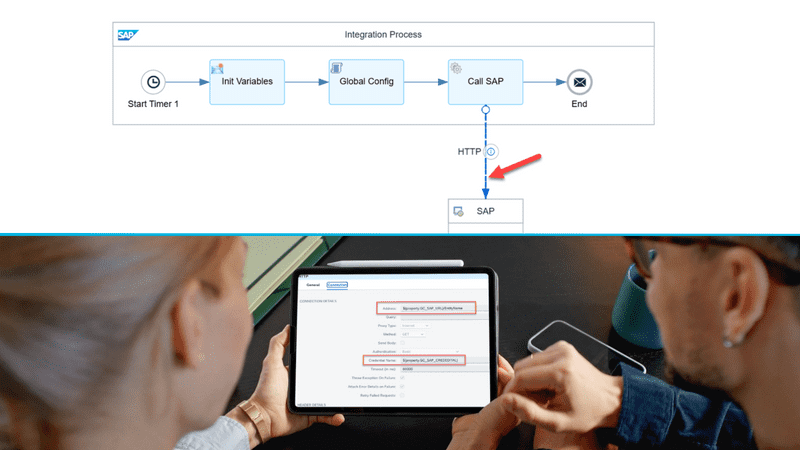
*This configuration tells the adapter to fetch the necessary connection details from the message properties just before making the outbound call, ensuring it connects to the correct backend system for that specific iflow execution.
The Central Hub: The Heart of Dynamic Logic
A key component of this solution is the central configuration hub Jan developed. It's a simple Groovy script that acts as the single source of truth for all environment-specific parameters.
- Centralized structure: The script contains a map that stores the SAP system URLs and credential aliases for each environment (DEV, TEST, PROD).
- Effortless maintenance: If a SAP system URL or a credential alias changes, you only need to update it in one place within this script. The change automatically propagates to all relevant solutions, saving time and preventing errors.
- Security first: As Jan emphasizes, sensitive credentials should never be hard-coded into the script. Instead, they are referenced by aliases that point to securely stored credentials within SAP Integration Suite.
„Storing all sensitive information centrally is a fundamental security practice. It prevents credentials from being exposed in the code and ensures they are managed securely and with minimal effort,“ adds our Integration Architect, Jan Tůma.
If you are interested in how we tackle complex integration challenges in SAP, follow us on LinkedIn. We plan to share more of our know-how with you soon.