This platform is essential for ensuring a smooth flow of information, which is fundamental for efficient and agile business operations.
We introduce Jan Tůma, an Integration Architect from coalsoft s.r.o., whose expertise and innovative approaches are the source of inspiration for this series. Jan Tůma, a recognized expert in SAP integrations, regularly shares his know-how, which underscores coalsoft's commitment to disseminating practical, cutting-edge knowledge in the SAP field. This approach not only enhances the credibility of the content but also strategically positions coalsoft as a leading expert in SAP integration, demonstrating their ability to solve complex problems and potentially opening new business opportunities.
Defining the problem: Why static configurations fall short in enterprise environments?
In large enterprises, a common scenario is the existence of multiple backend SAP environments, such as Development, Quality Assurance/Test, and Production systems. Each of these environments requires different connection details. The fundamental limitation is that default receiver adapters in SAP Integration Suite are configured with static endpoint URLs and credential names. This static nature leads to significant problems.
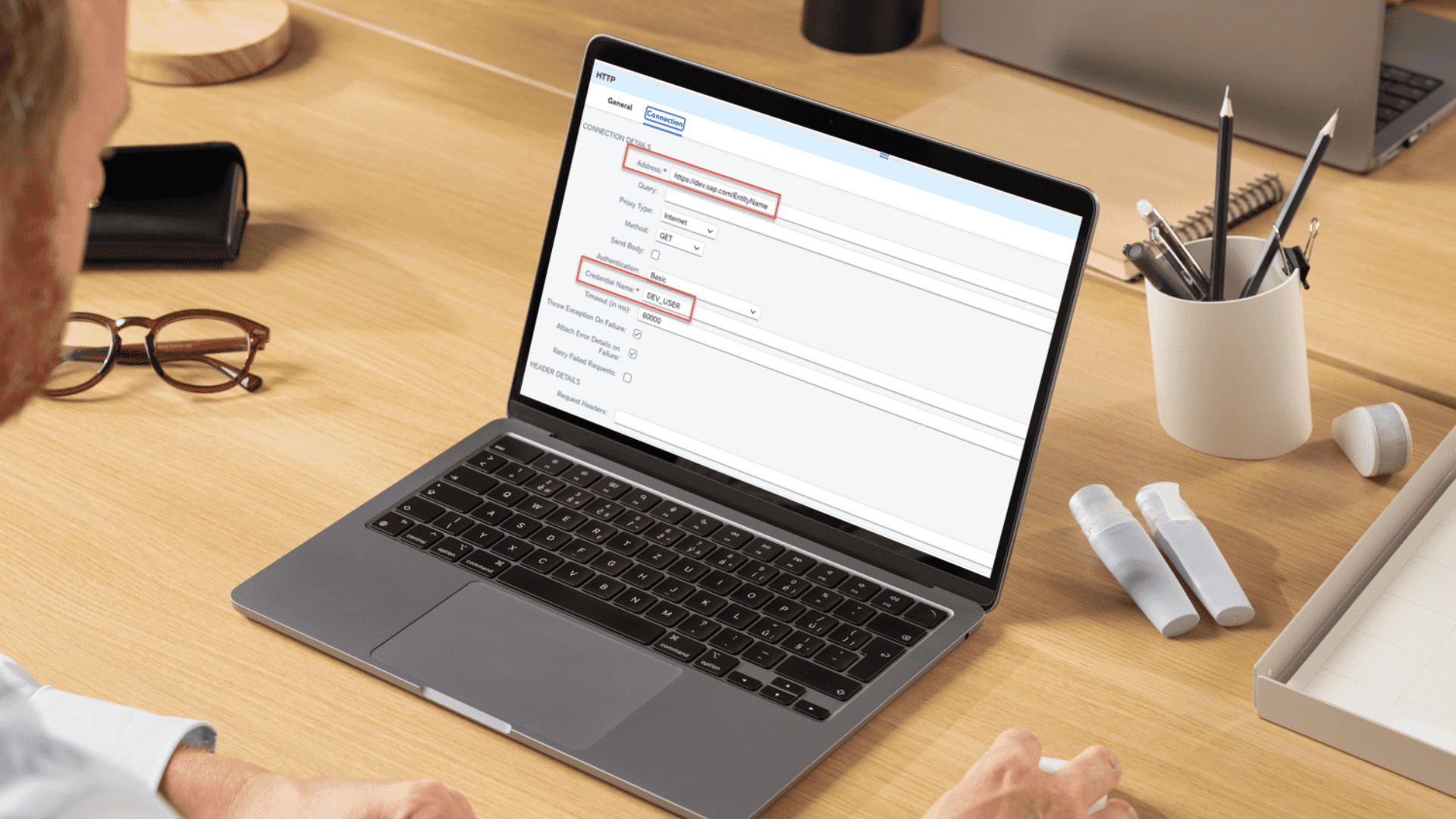
„As we often see in practice, one of the main issues is the duplication of integration flow (iflow) logic. To enable an iflow to connect to different target systems based on the deployed instance, separate iflow artifacts are often created for each environment, such as MyIflow_DEV, MyIflow_TEST, MyIflow_PROD,“ says Jan Tůma. This results in redundant development effort and the proliferation of similar integration logic. The apparent simplicity of static configuration quickly turns into significant hidden costs and a barrier to agility in complex enterprise environments."
„Another significant problem,“ Jan Tůma continues, „is manual configuration changes. The process of manually adjusting adapter configurations on deployed iflow instances when propagating integrations between environments is highly error-prone and time-consuming.[1] This introduces human errors and slows down deployment cycles.“ Any update or bug fix in the core integration logic requires changes across multiple duplicated iflows, significantly increasing maintenance effort, testing cycles, and the risk of inconsistency. These aspects directly impact operational overhead, increase the risk of production errors due to manual interventions, and slow down the time-to-market for new integrations.
Introducing dynamic configuration: A paradigm shift for agile integration
„Dynamic configuration presents an elegant and powerful solution to the challenges posed by static settings,“ explains Jan Tůma.
It allows a single integration flow artifact to intelligently serve multiple backend environments without requiring code changes or manual reconfigurations.
„At the core of this approach,“ Jan Tůma adds, „is the use of a message property as an environment identifier (e.g., ENV) to dynamically look up environment-specific connection details (such as SAP system URLs and credential aliases) from a central, controlled source within the iflow itself. This approach aligns with broader principles of modern software development and DevOps methodologies.“
The „one artifact, multiple environments“ principle is a cornerstone of practices where artifacts are built once and configured for different deployment targets. By adopting dynamic configuration, organizations not only solve an SAP-specific problem but also align their integration strategy with industry best practices that promote automation, repeatability, and agility across the entire IT landscape. This elevates the discussion from a mere technical fix to a strategic tool for digital transformation and operational streamlining.
Overview of benefits: Why dynamic configuration matters for your business
The technical advantages of dynamic configuration translate into tangible business benefits, demonstrating its strategic value:
Cost Efficiency: „It enables running integrations for multiple backend systems on a single SAP Integration Suite tenant by deploying multiple instances of the same iflow artifact,“ Jan Tůma emphasizes. This potentially reduces licensing or infrastructure costs associated with multiple tenants.
Simplified Development: „Developers only need to create and maintain one core iflow artifact and one central configuration map, drastically reducing development effort and accelerating the deployment of new integrations,“ Jan Tůma explains.
Easier Maintenance: „Updates to core integration logic are centralized within a single iflow artifact. Configuration changes are isolated to the central configuration map, requiring only a single redeployment of the iflow artifact, streamlining the maintenance process,“ Jan Tůma adds.
Controlled Deployment: „Deployed instances are clearly differentiated solely by setting an externalized parameter, allowing for clear identification (e.g., „MyIflow – DEV“) and better management of integration environments,“ Jan Tůma describes.
Reduced Error Potential: „It minimizes manual, error-prone configuration changes on deployed artifacts by automating and centralizing the configuration process, leading to more reliable and stable integrations,“ Jan Tůma concludes.
„These benefits are not just technical conveniences,“ Jan Tůma points out.
They directly impact an organization's operational resilience and financial performance. Reduced error potential translates to fewer production incidents, shorter downtimes, and improved data quality. Simplified development and easier maintenance lead to faster feature delivery, reduced operational costs, and a lower total cost of ownership for integration solutions. This pattern transforms SAP integration from a potential bottleneck into a strategic asset, enabling greater business agility and stability.